Skip to content

Amenities and Services

Amenities and Services in Schmitz Hall

Schmitz Hall Amenities and Services

Per WAC 478-116-199, bicycles may not be parked anywhere in Schmitz Hall. For bicycle parking resources elsewhere on campus, visit Transportation Services.

All conference rooms in Schmitz Hall are managed by individual departments. Use of departmental conference rooms requires authorization from the department in question.

Most deliveries, loading, and unloading can be made using the 30-minute load/unload zone on NE 41st Street, adjacent to the northwest corner of Schmitz Hall. For larger jobs, Schmitz Hall has a loading dock that can be utilized. The loading dock is locked behind a padlocked fence and a closed garage door. If you do not already have access to the loading dock via your department, advance notice will be required. Please contact the Building Coordinator for more information.

The Building Coordinator is responsible for tracking and assigning building keys and keycard access for all doorways in Schmitz Hall.

Departmental Authorized Requestors (DARS)
Units in Schmitz Hall may designate certain people to be the Departmental Authorized Requestors (DARs) for their unit. Only DARs may request new keys or keycard access on behalf of their units. Departments may designate anyone within their unit to be a DAR. DARs are responsible for managing access for their department and are expected to be aware of departmental operations.

Requesting Keys
DARs must first check their stock of unit keys. If there is no spare copy of a key held by the unit, the DAR must request additional copies from the Building Coordinator using the Key Request Form. Do not send requests for Schmitz Hall keys to the UW Lock Shop. Only DARs can fill out the Key Request Form.

Workday Worktags are a required part of the Key Request Form. Your unit will only be charged if new keys need to be fabricated by the UW Lock Shop.

Although you can request more than one key per form submission, each submission must correspond to only one employee. Each employee for which you are requesting keys will necessitate a separate form entry. Once a key is received, it remains the responsibility of the unit to keep track of their keys and who possesses them.

Requesting Keycard Access
Schmitz Hall’s exterior doors, hallway doors, stairwell doors, and many unit suite entryway doors are controlled by card reader access. Student, staff, and faculty Husky Cards serve as the access card for these types of doors on campus. The doors in Schmitz Hall are restricted and can only be unlocked by individuals with pre-approved badge access. DARs must fill out the Keycard Access Request Form for each individual who needs access to Schmitz Hall. Only DARs can fill out the Keycard Access Request Form.

Each submission must correspond to only one employee. Each employee for which you are requesting keycard access will necessitate a separate form entry. Please ensure the individual for whom you are requesting keycard access is in possession of an active Husky Card before requesting building access. Husky Cards are managed by the Husky Card Office, a division of Housing and Food Services.

The card readers are installed and maintained by the CAAMS group (Campus Automated Access Management System), a part of UW Facilities.

Temporary Keycards
Units may request a temporary keycard checkout for external visitors, vendors, volunteers, visiting scholars, or event staff. A temporary keycard is a separate card from a Husky Card and is loaned out by the Building Coordinator at their discretion. Please reach out to the Building Coordinator to request temporary keycards. The fee for losing a temporary keycard is $25.

Revoking Keycard Access and Employee Offboarding
If an individual no longer needs card access to Schmitz Hall or to your unit’s spaces, DARs must fill out the Key and Keycard Offboarding Request Form. Only DARs may fill out this form. To ensure the security of the building, it is important for DARs to work with unit supervisors to get keys back from offboarding employees and to revoke keycard access by filling out this form promptly during personnel offboarding.

Although building keycard access is automatically discontinued when personnel leave the UW, this is not the case for personnel transferring to a new department. Additionally, informing the Building Coordinator of any personnel change is helpful for maintaining continuity of other building coordination services such as the employee directory and key tracking.

Key Tracking and Audits
Units are responsible for tracking all keys in their possession. This includes keys which are issued to or returned by unit personnel, keys kept in stock, and keys which may have been lost. Any keys which are not assigned to an individual should be kept in a secure location. Units must provide information about their key assignments to the Building Coordinator upon request.

Lost Keys
Lost keys must be reported to the Building Coordinator as soon as possible. Lost keys must also be reported to the UW Police Department as a lost or stolen item. Units should conduct a risk assessment for the lost key. It is strongly recommended that all spaces opened by a lost key are rekeyed. Rekeys are done at the expense of the department which lost or owned the key. Departments assume all risks if they choose not to rekey following the loss of a key. For this reason, keys should not be labeled with information identifying the key as a UW key or identifying the area or door which it opens. Keys returned to lost and found or the lock shop can be identified by the unique key number inscribed on the key.

Rekeys
All rekey requests, including requests to install CAAMS card readers or number pad locks, are submitted by the unit directly to UW Facilities. Requests are also reviewed and approved by the Building Coordinator during this process. Rooms and areas may be rekeyed due to department space transfers, lost keys, or a need for more security. Rekeys are done at the expense of the unit.

Keys no longer needed
Obsolete keys, unidentified keys, or keys that are no longer needed can be returned to the Building Coordinator.
Schmitz Hall room 240 is designated as a Lactation Space for UW faculty, staff, and students only. Using the lactation room requires signing a user agreement and checking out a key from the Building Coordinator. The Lactation Space is also a bookable and reservable room in UW calendars. Lactation Space amenities include a Medela Symphony breast pump, refrigerator, soft seating, and cleaning supplies. Please contact the Building Coordinator in advance if you are planning to utilize this space.

MISSING LACTATION ROOM PHOTO

Common Areas – Building Coordinator

The Building Coordinator is responsible for submitting work orders for all common areas in Schmitz Hall. This includes lobbies, hallways, stairwells, elevators, public restrooms, and other shared spaces.

Please notify the Building Coordinator of any issues by utilizing the Maintenance Request Form. Anyone may submit this form.

Examples of Building Coordinator Maintenance Requests

  • Restroom product refills or clean up.
  • Water Intrusion from windows, ceilings, or plumbing in non-assigned spaces.
  • Pests, mold, or asbestos concerns in non-assigned spaces. (Report to EH&S)
  • Lights, outlets, or other electrical issues in non-assigned spaces.
  • General upkeep and cleaning in non-assigned spaces.
  • Building exterior maintenance, including broken windows, trash cleanup, and graffiti in non-assigned spaces and the outside of the building.
  • Elevator issues such as immobile elevators or non-functioning buttons.

Assigned Spaces – Individual Units

It remains the responsibility of each unit in Schmitz Hall to report any issues in their assigned spaces directly to UW Facilities by utilizing UW Facilities’ Request a Service form. This allows UW Facilities to contact the unit directly for scheduling and access. Units are also responsible for purchasing and maintaining supplies and signage for all assigned spaces within that unit. This includes all office spaces and suites, reception areas, kitchenettes, conference rooms, and storage spaces.

Examples of maintenance requests that assigned spaces may request include:

  • Any of the previous examples but within assigned areas.
  • Rekeying, or installing number pads or CAAMS card readers.
  • Hanging signs or art.
  • Room too hot/too cold.
  • Moving or surplus requests.
  • Minor renovations.

Schmitz Hall units and departments do not need prior approval to post on any bulletin boards inside of Schmitz Hall.

For all others, posting and signage in Schmitz Hall must be approved by Building Coordination.

Location
This posting approval process applies only to the bulletin board in the Schmitz Hall first floor lobby.

Approval
Approval for posting can be obtained by filling out the Schmitz Hall Posting Approval request form. Building Coordination does not have physical stamps for poster approval; you must provide us with a digital copy via the request form.

MISSING APPROVAL FORM

Any posting without prior approval will be removed.

Approval Prerequisites

  • Only UW colleges, schools, departments, units, and RSOs are allowed to post signs inside of Schmitz Hall. All other postings may go on the outdoor posting kiosks, which are not monitored or moderated.
  • Postings may only be posted on the approved bulletin boards and surfaces in the first floor lobby, to the left of the elevators. Posting is not permitted on the walls or windows of the building, on the inside or outside of the elevator doors, or in the restrooms.
  • Events or announcements must be UW-affiliated. The name of the sponsoring college, department, unit, RSO, and/or course ID must be clearly displayed on the announcement.
  • Postings must be 11×17 inches or smaller.
  • Approval is valid for four weeks or until the end of the current academic quarter (whichever is longer) OR until after your advertised event is over.
  • Individuals must post their own notices at the approved locations.

Department Bulletin Boards
Departmental bulletin boards, which may be affixed in shared spaces near the door to their assigned space, are for the use of that department only. Approval of that department must be acquired to post on departmental bulletin boards.

Schmitz Hall 585 is designated as a staff break room for Schmitz Hall employees. Please contact your supervisor or the Building Coordinator for access instructions. Amenities include tables, chairs, sink, microwave, and expansive skyline views.

MISSING STAFF BREAK ROOM PHOTO

Some storage spaces are shared with multiple units. Please follow these storage room guidelines to ensure equitable access and minimize clutter.

  1. Do not block the aisles, doorways, or entrances to storage ranges.
  2. Label your items with your name or your office name and use only the shelves or areas designated to your unit.
  3. Dispose of trash and recycle in the hallway.
  4. You must schedule your own surplus pickups for your own items.
  5. Do not leave surplus items on the floor without having a surplus pickup planned for those items.
  6. Make sure the door is closed and locked and the lights are off when you leave.

Trash and recycle services in individual offices are self-service as part of UW Recycling’s MiniMax program. Food waste, paper towels, and food-soiled paper and cardboard can go in the compost bins. Certain other categories of items have special pickup locations in Schmitz Hall:

  • Cardboard boxes must be broken down and flattened. Small volumes of cardboard may be placed in the 90-gallon containers for mixed paper in the basement. If your boxes do not fit in these containers or you have a large amount of cardboard, you must take the cardboard out to the recycling dumpster in the dumpster corral in the corner of the C9 parking lot behind the building.
  • eMedia including disks, tapes, batteries, small electronics, and inkjet cartridges, have a special collection bin located on the third floor lobby.
  • Printer and Toner Cartridges can be left in the basement lobby to the right of the elevators.
  • Styrofoam blocks and peanuts can be left on the top right of the mailbox cabinet in the basement.

There are drink and a snack vending machines in the second floor lobby of Schmitz Hall. To request refunds or report broken machines, email vending@uw.edu.

Emergency Information & Procedures

In the event of an emergency, Gerberding Hall follows the procedures laid out by Environmental Health and Safety and UW Emergency Management.

Fire Safety and Evacuation Plan (FSEP)

Each building on campus has a Fire Safety and Evacuation Plan (FSEP) document with specific instructions for that building. Gerberding Hall units should keep a printed copy of the most recent FSEP in a conspicuous place, disseminate it widely when updates are published, and include it in employee onboarding materials.

MISSING GERBERDING HALL FSEP DOCUMENT

Evacuation Wardens

Each unit within Gerberding Hall must designate at least one person to act as evacuation warden. Evacuation wardens help ensure people in their unit and area evacuate, direct people to the evacuation assembly point, prevent people from re-entering the building until the all-clear is given, and report any info about the nature of the emergency or people still known to be in the building to the evacuation director. Evacuation wardens must take a free, 30-minute Emergency Evacuation online training. It is recommended to have as many people as possible take the training to be an evacuation warden, as it helps ensure coverage for absences and hybrid work schedules.

Emergency Assembly Point (EAP) Location

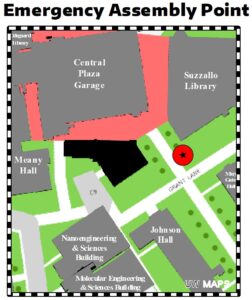
During a building evacuation, all building occupants must congregate at the designated Evacuation Assembly Point (EAP). Gerberding Hall’s EAP is the lawn on Grant Lane between Suzzallo Library and Mary Gates Hall. It is important to remain at the EAP, as that is the only location where EH&S and fire department personnel will give a verbal “all-clear” to re-occupy the building.

Map depicting the emergency assembly point (EAP) for Gerberding Hall. The EAP is denoted by a black star in a red circle.
Emergency assembly point for Gerberding Hall

Defibrillators

Gerberding Hall is equipped with a Phillips HeartStart Automated External Defibrillator (AED). The AED is located in the main lobby to Red Square on the first floor. The AED is registered with King County, so emergency dispatchers know its location in the event of an emergency. The AED is in an alarmed cabinet which emits a high pitched tone when opened, alerting those nearby of a potential emergency situation. There is also a second AED located in the hallway on the 4th floor. The Building Coordinator is responsible for upkeep on both AEDs.

If either AED is ever used, notify the Building Coordinator as soon as possible.

Elevators

If someone is stuck in a Gerberding elevator, press the emergency call button on the elevator panel. If unable to do so, please call the UW Facilities 24/7 Customer Care line at 206-685-1900 and press 0 for emergencies.

Amenities and Services

Amenities and Services in Gerberding Hall

Gerberding Hall Amenities and Services

Gerberding Hall has a small bike storage room with capacity for approximately six to eight bikes, ebikes, and scooters on a first-come, first-served basis. The room is reserved for employees whose primary workstation is in Gerberding Hall. To request access to the bike storage room, please contact the Building Coordinator.

Per WAC 478-116-199, bicycles may not be parked anywhere else in the building. For bicycle parking resources elsewhere on campus, visit Transportation Services.

Gerberding Hall room 142 is available to reserve by UW entities. This process is managed by the UW Board of Regents office. For more information, please see the Gerberding 142 Conference Room webpage.

Deliveries and Loading/unloading at Gerberding Hall may take place in the C9 parking lot behind the building. The door to the basement from the parking lot is locked and only accessible to UW employees with prior approval, so plan to meet deliveries at that door or direct them to the front door to the building on Red Square, which is unlocked during business hours.

The Building Coordinator is responsible for tracking and assigning building keys and keycard access for all doorways in Gerberding Hall.

Departmental Authorized Requestors (DARS)
Units in Gerberding Hall may designate certain people to be the Departmental Authorized Requestors (DARs) for their unit. Only DARs may request new keys or keycard access on behalf of their units. Departments may designate anyone within their unit to be a DAR. DARs are responsible for managing access for their department and are expected to be aware of departmental operations.

Requesting Keys
DARs must first check their stock of unit keys. If there is no spare copy of a key held by the unit, the DAR must request additional copies from the Building Coordinator using the Key Request Form. Do not send requests for Gerberding Hall keys to the UW Lock Shop. Only DARs can fill out the Key Request Form.

Workday Worktags are a required part of the Key Request Form. Your unit will only be charged if new keys need to be fabricated by the UW Lock Shop.

Although you can request more than one key per form submission, each submission must correspond to only one employee. Each employee for which you are requesting keys will necessitate a separate form entry. Once a key is received, it remains the responsibility of the unit to keep track of their keys and who possesses them.

Requesting Keycard Access
Gerberding Hall’s exterior doors, hallway doors, stairwell doors, and many unit suite entryway doors are controlled by card reader access. Student, staff, and faculty Husky Cards serve as the access card for these types of doors on campus. The doors in Gerberding Hall are restricted and can only be unlocked by individuals with pre-approved badge access. DARs must fill out the Keycard Access Request Form for each individual who needs access to Gerberding Hall. Only DARs can fill out the Keycard Access Request Form.

Each submission must correspond to only one employee. Each employee for which you are requesting keycard access will necessitate a separate form entry. Please ensure the individual for whom you are requesting keycard access is in possession of an active Husky Card before requesting building access. Husky Cards are managed by the Husky Card Office, a division of Housing and Food Services.

The card readers are installed and maintained by the CAAMS group (Campus Automated Access Management System), a part of UW Facilities.

Temporary Keycards
Units may request a temporary keycard checkout for external visitors, vendors, volunteers, visiting scholars, or event staff. A temporary keycard is a separate card from a Husky Card and is loaned out by the Building Coordinator at their discretion. Please reach out to the Building Coordinator to request temporary keycards. The fee for losing a temporary keycard is $25.

Revoking Keycard Access and Employee Offboarding
If an individual no longer needs card access to Gerberding Hall or to your unit’s spaces, DARs must fill out the Key and Keycard Offboarding Request Form. Only DARs may fill out this form. To ensure the security of the building, it is important for DARs to work with unit supervisors to get keys back from offboarding employees and to revoke keycard access by filling out this form promptly during personnel offboarding.

Although building keycard access is automatically discontinued when personnel leave the UW, this is not the case for personnel transferring to a new department. Additionally, informing the Building Coordinator of any personnel change is helpful for maintaining continuity of other building coordination services such as the employee directory and key tracking.

Key Tracking and Audits
Units are responsible for tracking all keys in their possession. This includes keys which are issued to or returned by unit personnel, keys kept in stock, and keys which may have been lost. Any keys which are not assigned to an individual should be kept in a secure location. Units must provide information about their key assignments to the Building Coordinator upon request.

Lost Keys
Lost keys must be reported to the Building Coordinator as soon as possible. Lost keys must also be reported to the UW Police Department as a lost or stolen item. Units should conduct a risk assessment for the lost key. It is strongly recommended that all spaces opened by a lost key are rekeyed. Rekeys are done at the expense of the department which lost or owned the key. Departments assume all risks if they choose not to rekey following the loss of a key. For this reason, keys should not be labeled with information identifying the key as a UW key or identifying the area or door which it opens. Keys returned to lost and found or the lock shop can be identified by the unique key number inscribed on the key.

Rekeys
All rekey requests, including requests to install CAAMS card readers or number pad locks, are submitted by the unit directly to UW Facilities. Requests are also reviewed and approved by the Building Coordinator during this process. Rooms and areas may be rekeyed due to department space transfers, lost keys, or a need for more security. Rekeys are done at the expense of the unit.

Keys no longer needed
Obsolete keys, unidentified keys, or keys that are no longer needed can be returned to the Building Coordinator.

MISSING LACTATION ROOM INFO

Common Areas – Building Coordinator

The Building Coordinator is responsible for submitting work orders for all common areas in Gerberding Hall. This includes lobbies, hallways, stairwells, elevators, public restrooms, and other shared spaces.

Please notify the Building Coordinator of any issues by utilizing the Maintenance Request Form. Anyone may submit this form.

Examples of Building Coordinator Maintenance Requests

  • Restroom product refills or clean up.
  • Water Intrusion from windows, ceilings, or plumbing in non-assigned spaces.
  • Pests, mold, or asbestos concerns in non-assigned spaces. (Report to EH&S)
  • Lights, outlets, or other electrical issues in non-assigned spaces.
  • General upkeep and cleaning in non-assigned spaces.
  • Building exterior maintenance, including broken windows, trash cleanup, and graffiti in non-assigned spaces and the outside of the building.
  • Elevator issues such as immobile elevators or non-functioning buttons.

Assigned Spaces – Individual Units

It remains the responsibility of each unit in Gerberding Hall to report any issues in their assigned spaces directly to UW Facilities by utilizing UW Facilities’ Request a Service form. This allows UW Facilities to contact the unit directly for scheduling and access. Units are also responsible for purchasing and maintaining supplies and signage for all assigned spaces within that unit. This includes all office spaces and suites, reception areas, kitchenettes, conference rooms, and storage spaces.

Examples of maintenance requests that assigned spaces may request include:

  • Any of the previous examples but within assigned areas.
  • Rekeying, or installing number pads or CAAMS card readers.
  • Hanging signs or art.
  • Room too hot/too cold.
  • Moving or surplus requests.
  • Minor renovations.

Gerberding Hall units and departments do not need prior approval to post on their own departmental bulletin boards or in their assigned spaces. For all other areas, posting and signage is only allowed for “Day of” directional or wayfinding signage for events being hosted inside of the building, and only if it adheres to the following rules:

  • Posting inside Gerberding Hall is only allowed for events and services hosted or sponsored by UW colleges, schools, departments, units, and RSOs.
  • Posting may not be taped to any wood, plaster, drywall, stone, or brick surfaces, nor on the inside or outside of the elevator doors.
  • The posting must clearly identify the event name, date, and sponsoring organization.
  • The posting must not block the entire surface area of any window or windowpane.
  • The posting must be 11×17 inches or smaller.

Trash and recycle services in individual offices are self service as part of UW Recycling’s MiniMax program. Food waste, paper towels, and food-soiled paper and cardboard can go in the compost bins. Certain other categories of items have special pickup locations in Gerberding Hall:

  • Cardboard boxes must be broken down and flattened. Small volumes of cardboard may be placed in the 90-gallon containers for mixed paper in the basement. If your boxes do not fit in these containers or you have a large amount of cardboard, you must take the cardboard out to the recycling dumpster in the dumpster corral in the corner of the C9 parking lot behind the building.
  • eMedia including disks, tapes, batteries, small electronics, and inkjet cartridges, have a special collection bin located in the basement hallway.
  • Printer and Toner Cartridges can be left on the top left of the mailbox cabinet in the basement.
  • Styrofoam blocks and peanuts can be left on the top right of the mailbox cabinet in the basement.

Some storage spaces are shared with multiple units. Please follow these storage room guidelines to ensure equitable access and minimize clutter.

  1. Do not block the aisles, doorways, or entrances to storage ranges.
  2. Label your items with your name or your office name and use only the shelves or areas designated to your unit.
  3. Dispose of trash and recycle in the hallway.
  4. You must schedule your own surplus pickups for your own items.
  5. Do not leave surplus items on the floor without having a surplus pickup planned for those items.
  6. Use your best judgement when placing items on the “free to take” shelves. Most of it is just surplus.
  7. Make sure the door is closed and locked and the lights are off when you leave.

There are drink and snack vending machines in the basement of the Gerberding Hall. To request refunds or report broken machines, email vending@uw.edu.

Gerberding Hall

Gerberding Hall is located on the upper campus of the University of Washington on Red Square.

Contact Information

Mailing Address

1704 NE Grant Lane
Seattle, WA 98195

Map: Campus Map
Facility Code: GRB

Building Hours

8 a.m. – 5 p.m., Monday-Friday, excluding holidays.

Gerberding Hall Office Directory

Unit/Website GRB Office Email/Phone
Academic Personnel & Faculty (ACF) 401 acadpers@uw.edu
206-221-8927
Board of Regents (BoR) 139 regents@uw.edu
206-543-1633
Campus Community & Safety (CCS) 100
CCS Husky Assist 100 206-543-9331
CCS SafeCampus 100 safecampus@uw.edu
CCS UW Emergency Management 100 disaster@uw.edu
206-543-9331
Center for Teaching and Learning (CTL) 134 teaching@uw.edu
206-543-6588
Executive Office Shared Environment (EOSE) 340
Faculty Senate & Governance 036 206-543-5939
Gerberding Bell Ringers 502 woodgate@uw.edu
Office of External Affairs (OEA) 240
Office of Global Affairs (OGA) 022 uwoga@uw.edu
Office of Research Central 080
Office of Student Life 101 stulife@uw.edu
206-543-4972
Office of the President 301 president@uw.edu
Office of the Provost 301 provost@uw.edu
Parent and Family Programs 229 uwparent@uw.edu
University Advancement (UA) 201 osvp@uw.edu
UA UW Foundation 201
UA UW Retirement Association B080 retiremt@uw.edu
206-543-8600
University Marketing & Communications (UMAC) 294
UMAC UW News 294 uwnews@uw.edu
University Policy and Rules Office 340 rules@uw.edu

History of Gerberding Hall

Gerberding Hall was built in 1949 by Strand & Sons Construction. Designed by architects Victor N. Jones and John T. Jacobsen, it was originally called the Administration Building until being rededicated in 1995 in honor of William P. Gerberding, UW’s 27th President from 1979-1995. A portrait of President Gerberding by artist Margaret Sargent hangs in the first floor lobby.

As one of UW’s many collegiate gothic style buildings, Gerberding Hall has many artistic elements, including bosses and gargoyles, spread across its architecture.
The spandrels between floors one and two feature three bronze seals of the university, the state, and the territory.

Along the cornice are 24 statues and shields representing academic disciplines. They were sculpted by Dudley Pratt, professor at the UW School of Art from 1925-1952.

In 2008, Gerberding Hall’s tower became home to a set of eight change ringing bells, generously donated by Gordon Stuart Peek.

Emergency Information & Procedures

Emergency Information

In the event of an emergency, Schmitz Hall follows the procedures laid out by Environmental Health and Safety and UW Emergency Management.

Fire Safety and Evacuation Plan (FSEP)

Each building on campus has a Fire Safety and Evacuation Plan (FSEP) document with specific instructions for that building. Schmitz Hall units should keep a printed copy of the most recent FSEP in a conspicuous place, disseminate it widely when updates are published, and include it in employee onboarding materials.

MISSING SCHMITZ HALL FSEP DOCUMENT

Evacuation Wardens

Each unit within Schmitz Hall must designate at least one person to act as evacuation warden. Evacuation wardens help ensure people in their unit and area evacuate, direct people to the evacuation assembly point, prevent people from re-entering the building until the all-clear is given, and report any info about the nature of the emergency or people still known to be in the building to the evacuation director. Evacuation wardens must take a free, 30-minute Emergency Evacuation online training. It is recommended to have as many people as possible take the training to be an evacuation warden, as it helps ensure coverage for absences and hybrid work schedules.

Emergency Assembly Point (EAP) Location

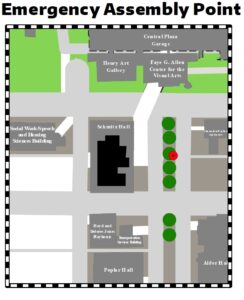
During a building evacuation, all building occupants must congregate at the designated Evacuation Assembly Point (EAP). Schmitz Hall’s EAP is the gravel area in the median of NE Campus Parkway, directly South of the building. Be sure to utilize the crosswalks when going to or from the EAP. It is important to remain at the EAP, as that is the only location where EH&S and fire department personnel will give a verbal “all-clear” to re-occupy the building.

The emergency assembly point for Schmitz Hall is denoted with the black star in the red circle.
Emergency assembly point for Schmitz Hall.

Elevators

If someone is stuck in a Schmitz elevator, press the emergency call button on the elevator panel. If unable to do so, please call the UW Facilities 24/7 Customer Care line at 206-685-1900 and press 0 for emergencies.

Schmitz Hall

Schmitz Hall is located between the west and upper campus of the University of Washington.

Contact Information

Mailing Address

1410 NE Campus Parkway
Seattle, WA 98195

Map: Campus Map
Facility Code: SMZ

Building Hours

8 a.m. – 5 p.m., Monday-Friday, excluding holidays.

Schmitz Hall Office Directory

Unit/Website SMZ Office Email/Phone
Academic Strategy & Affairs-Information Services (ASAIS) 264 asahelp@uw.edu
Center for International Relations & Cultural Leadership Exchange (CIRCLE) 250 uwcircle@uw.edu
206-685-4004
Counseling Center 401 206-543-1240
Crisis Support: 206-616-7777
Division of Enrollment Management (DOEM) 301
DOEM Admissions, Office of 301 askuwadm@uw.edu
206-543-9686
DOEM International Student Services (ISS) 459 uwiss@uw.edu
DOEM Student Financial Aid (OSFA), Office of 105 osfa@uw.edu
206-543-6101
DOEM University Registrar (OUR), Office of the 260 regoff@uw.edu
DOEM Veterans Education Benefits Office (VEBO) 520 veteran@uw.edu
206-543-6122
Executive Office Shared Environment (EOSE) 474
Office of Minority Affairs and Diversity (OMAD) 375 omadfd@uw.edu
206-685-0518
Student Fiscal Services (SFS) 129 sfshelp@uw.edu
206-543-4694
Testing Center 440 drstest@uw.edu
206-221-9117
UW Study Abroad 453 studyabroad@uw.edu
206-221-4404
Work Study Office 520 workstd@uw.edu

History of Schmitz Hall

Schmitz Hall was built in 1970. Designed by architecture firm Waldron & Pomeroy Architects, Schmitz Hall takes the shape of an “inverted ziggurat” and is built in the brutalist style. The building is named after Dr. Henry Schmitz, who served as UW’s 23rd president from 1952-1958. A portrait of Dr. Schmitz by artist William Hixson hangs in the landing of the main lobby stairs.

In the first floor lobby stands a grandfather clock that originated from the Schmitz family homestead in West Seattle.

The lobby also houses four 18-foot-tall wool tapestries. Depicting the four seasons, the tapestries were created by local artist Marilyn “Mic” Hemstad. One of the architects, Gerry Pomeroy, who was also a lecturer for the College of Architecture at the time, selected the artist to design the tapestries specifically for this building, where they have been hanging on display since the building opened.

Offboarding Keys & CAAMS – Request Form

Maintenance – Request Form

Offboarding Keys & CAAMS

The purpose of the Offboarding Keys & CAAMS form is to contact the Schmitz Hall & Gerberding Hall Building Coordinator when offboarding an employee to transfer or return keys and/or revoke CAAMS/card reader access.

Submission of this request will create an RT ticket sent to the Schmitz Hall & Gerberding Hall Building Coordinator. Tickets will be reviewed by the Building Coordinator, and further information or approval may be requested/required.

Offboarding Keys & CAAMS Form

CAAMS Request – Request Form

Sorry, you need to be an Authorized Requestor to view and be able to submit this form.